


Scooters are now part of everyday travel, yet crash and injury concerns still limit their potential. Cities want to reduce scooter accidents without stalling mobility, and that requires moving from abstract goals to practical, street-level action. This guide translates policy into design standards, program tools, and measurable routines that city teams can start using this quarter. For additional context on model behavior, spec trade-offs, and practical how-tos, see our Electric Scooter Reviews, compare Electric Scooter Specifications, and browse Electric Scooter Guides when shaping local rules and infrastructure.
The Case for Action (Crash patterns & where risk concentrates)
Crash risk concentrates in a few predictable contexts. First, intersections drive a large share of severe conflicts, especially with turning vehicles. Second, mid-block driveways create surprise conflicts where sightlines are tight. Third, night riding increases visibility challenges, particularly on corridors with poor lighting. Fourth, wet or gravelly surfaces shorten stopping distances and degrade handling. Finally, first/last-mile routes to transit, schools, and employment centers concentrate novice riders at predictable hours.
Therefore, the playbook below focuses on infrastructure that separates users, signal timing that clarifies priority, operational rules that keep sidewalks clear, and data routines that target micro-hotspots. Together, these measures reduce exposure, reduce speed, and improve visibility—the three levers that shape injury risk.
1) Build a Protected Micromobility Network
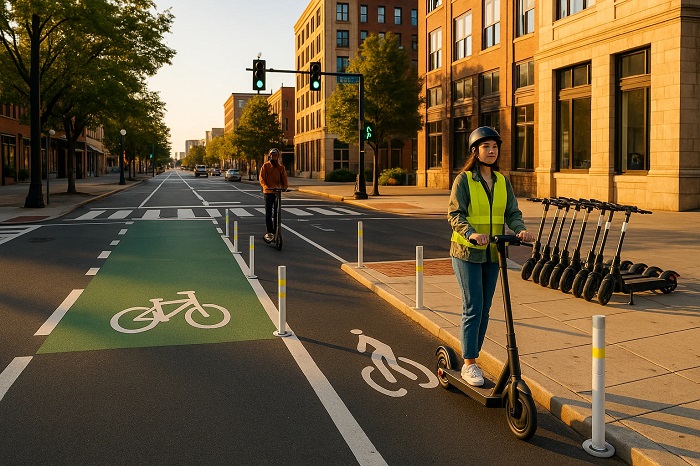
What it is. Provide curb- or post-separated lanes that continue through conflict points. The network should feel connected end-to-end, including across bridges, rail crossings, and pinch points. Riders choose the safest path when that path is the most direct and comfortable.
Quick-build vs. capital. Start with quick-build materials—striping, flexible posts, parking reallocation, modular curbs—then upgrade to concrete or raised paths as volumes and budgets grow. Maintain continuity across block faces; do not “drop” riders at busy intersections.
Design checklist.
- Minimum widths. Target 6 ft (1.8 m) per direction or 8–10 ft (2.4–3.0 m) for two-way shared lanes in constrained segments.
- Buffers. Add 2–3 ft (0.6–0.9 m) lateral buffer from moving traffic; use posts at 20–40 ft (6–12 m) spacing.
- Driveway crossings. Continue lane color/texture across driveways; shift the lane away from the curb before high-volume driveways to improve angles and sightlines.
- Pinch points. Use raised tables or vertical separation through bridges and underpasses; maintain width, do not force squeeze points.
- Surface quality. Avoid utility covers in the wheel track; set a rapid pothole response standard.
- Maintenance plan. Assign sweeping weekly during leaf and gravel seasons; prioritize snow clearance with small equipment.
2) Safer Intersections by Design
Tools to deploy.
- Daylighting. Remove the first parking space near corners to open sightlines.
- Protected signal phases. Give scooters and bikes a dedicated movement separate from turning vehicles.
- Leading pedestrian/bike intervals (LPIs). Provide 3–7 seconds of early start for people moving straight.
- Raised crossings. Elevate crosswalks and lane crossings to slow turning vehicles.
- Tighter curb radii. Reduce turning speeds by shrinking the corner radius.
- Bent-out crossings. Move the crossing away from the vehicle stop line to improve visibility and reduce right-hook risk.
Decision rules.
- Speed/volume. Above 25 mph (40 km/h) or high turn volumes → protected phases and raised corners.
- Complexity. Multiple driveways or skewed geometry → daylighting + bent-out crossings.
- School/transit proximity. Add LPIs and high-visibility markings by default.
- Freight routes. Use larger curb aprons with slow geometry, not wider radii.
Field audit checklist.
- Observe at peak and off-peak.
- Measure approach speeds and turning speeds.
- Map conflict points on each leg.
- Check signal timing, visibility, and marking condition.
- Document near-misses and yielding behavior.
- Log surface drainage and debris accumulation.
3) Manage Vehicle Speeds Where People Ride
Design-first speed management. Geometry sets behavior. Use road diets to reduce lanes and add separation. Install speed humps or cushions on cut-through streets. Narrow lanes to 10–11 ft (3.0–3.3 m) to curb speeds. Add gateway treatments—signing, textured entries, and trees—that signal a slower context.
Program tools. Set default 20–25 mph (32–40 km/h) limits for shared streets with high micromobility traffic, as allowed by law. Where legal, deploy automated enforcement around schools and transit. Align curb management to remove high-speed passing opportunities.
KPI ideas. Track 85th-percentile speeds before and after each project. Aim for a 3–7 mph (5–11 km/h) reduction on targeted segments. Pair speed measurement with injury rate tracking for causality.
4) Orderly Parking & Operating Zones
Parking corrals. Designate on-street corrals at corners or mid-block near major generators. Use modular rails or planters. Size for peak demand. Place guidance decals that align scooters parallel to the curb to preserve sidewalk width.
Geofenced zones. Establish slow-zones near plazas, schools, and transit hubs. Use “no-go” zones where riding is prohibited, such as narrow promenades or within sensitive park segments. Keep the map simple and predictable.
Sidewalk clearance and ADA. Maintain at least 6 ft (1.8 m) of clear sidewalk. Protect curb ramps and tactile warnings. Ensure sightlines at corners remain open for people using mobility devices.
Maintenance and compliance checks. Run time-of-day sweeps with city or operator teams. Focus on morning and evening peaks. Record violations, coach repeat offenders through in-app prompts, and rebalance fleets to prevent overflow.
5) Rider Education & Behavior Nudges
In-app modules. Require onboarding quizzes that highlight where to ride, how to yield, and how to park. Use short scenarios and local diagrams. Provide a “skills refresher” prompt after the first three trips.
Targeted prompts. Trigger messages near hotspots: “Use the protected lane ahead,” “Dismount to cross,” or “Park in the next corral.” Tie rewards to positive behavior streaks.
On-street cues. Refresh lane markings and add conflict-zone striping at driveways. Use clear pavement legends that match in-app guidance. At night, deliver visibility campaigns: reflective stickers on corrals, pole-mounted reminders, and voluntary helmet messaging without mandates.
Tone matters. Educate, don’t shame. Riders respond to clear rules, visible design, and small incentives.
6) Data, Hotspot Targeting & Rapid Response
Integrate sources. Combine police crash data, 311 complaints, hospital syndromic summaries where available, operator telemetry, and staff observations. Cross-check to locate micro-hotspots such as a single driveway or offset crosswalk.
Rapid response protocol. Move from cones → posts → permanent. First, stabilize the location with cones, daylight the corner, and add temporary signs. Next, install quick-build posts and color. Finally, deliver capital upgrades once results show sustained benefit.
Review cadence. Inspect hotspots weekly at first, then monthly. Document before/after speeds, yielding, and near-misses. Publish a short memo after each 90-day cycle to drive accountability.
7) Vehicle Standards & Fleet Upkeep
Practical specs that help safety.
- Brakes. Dual independent braking or robust combined systems; consistent modulation in wet conditions.
- Wheels/tires. Larger diameters handle cracks and rails better; maintain tread; specify minimum tire pressures.
- Lights/reflectors. Front and rear lights with adequate beam patterns; side reflectivity helps at driveways.
- Audible device. Bell or horn for courtesy alerts.
- Frames and stems. Stiff stems resist wobble; folding mechanisms should lock securely and pass periodic checks.
Operations and QC. Require daily visual inspections, weekly brake checks, and periodic fastener torque audits. Pull vehicles from service for light failures, brake issues, loose stems, or damaged tires. Track maintenance intervals and retired units.
Implementation Roadmap (90 / 180 / 365 Days)
90 days. Quick-build protected lanes on two top corridors. Daylight 20 intersections. Refresh conflict-zone markings and replace missing signs. Launch the first hotspot pilot with cones and posts. Start morning and evening parking sweeps.
180 days. Add protected phases at priority signals and deploy LPIs on school and transit approaches. Expand parking corrals in activity centers. Refine geofences based on parking and speed data. Run a rider training blitz with in-app prompts and pop-up skills areas.
365 days. Complete capital designs for the most successful quick-build segments. Procure modular curbs, signal hardware, and small snow equipment. Update vehicle standards and maintenance rules. Publish an annual safety report that shows projects, KPIs, and next steps.
Roles & Responsibilities
- Transportation/ DOT. Set standards, design projects, manage signals, and lead data integration.
- Public Works. Deliver quick-build installations, maintain surfaces, sweep lanes, and clear snow.
- Police/Enforcement. Focus on high-risk behaviors and school zones; support speed management within legal frameworks.
- Scooter Operators. Maintain fleets, run in-app education, geofence zones, and fund corrals where appropriate.
- Community Groups. Share feedback on hotspots, recruit for safety campaigns, and assist with pop-up education events.
- Elected Officials. Champion corridor conversions and budget the capital upgrades.
Monitoring to Reduce Scooter Accidents: KPIs & Continuous Improvement
Measure what matters, then adjust. Choose a small, stable set of indicators that link directly to design intent and rider experience. Review monthly for operations and quarterly for policy.
Suggested metrics.
- Crashes and injuries per trip.
- Serious injuries per million miles.
- Speed compliance on targeted segments.
- Parking compliance in corrals and on sidewalks.
- Corridor volumes by time of day.
- Time from hotspot identification to first treatment.
- Percentage of network with protected separation.
Close the loop with quick course corrections. If speeds remain high, add vertical elements or tighten geometry. If parking issues persist, move or expand corrals and add in-app prompts.
Table 1. Measures, Risks, Cost, Time, Owner
| Measure | Risk Addressed | Typical Cost Band | Time Horizon | Primary Owner |
|---|---|---|---|---|
| Protected micromobility lanes | Side-swipes, dooring, driveway conflicts | $$ | Weeks–Months (quick-build), Years (capital) | DOT & Public Works |
| Safer intersections | Turning conflicts, visibility | $$–$$$ | Months–Years | DOT (Signals) |
| Speed management | High-energy impacts | $–$$ | Weeks–Months | DOT & Police |
| Parking & zones | Sidewalk blockage, sightline issues | $ | Weeks | Operators & DOT |
| Education & nudges | Rule confusion, night riding | $ | Weeks | Operators & DOT |
| Data & rapid response | Persistent hotspots | $–$$ | Weekly–Months | DOT (Safety) |
| Vehicle standards & upkeep | Mechanical failures, poor visibility | $ | Ongoing | Operators |
Table 2. Intersection Treatments
| Intersection Treatment | Where to Use | Design Notes | Maintenance Needs |
|---|---|---|---|
| Daylighting | All corners with parking | Remove first space; add posts or curb | Sweep debris near posts |
| Protected signal phase | High turn volumes, ≥25 mph approaches | Separate conflicting moves | Maintain detection and timing |
| LPI (3–7 s) | School/transit approaches | Early start for straight-through users | Check clocks and firmware |
| Raised crossing | Driveways and minor legs | Slow turns, improve visibility | Inspect for plow damage |
| Tighter curb radii | Wide, fast corners | Reduce turning speeds | Keep drainage clear |
| Bent-out crossing | Multi-lane or skewed legs | Shift crossing 20–30 ft (6–9 m) from stop line | Refresh colored surfacing |
Table 3. KPIs, Targets, Data & Review
| KPI | Target | Data Source | Review Cadence |
|---|---|---|---|
| Crashes per 100,000 trips | Down 20% year-over-year | Police + operator trip counts | Quarterly |
| Serious injuries per million miles | Down 25% in 12 months | Hospital summary + operator mileage | Quarterly |
| 85th-percentile speed on target segments | ≤ 20–25 mph as posted | Speed tubes or video analytics | Monthly |
| Parking compliance | ≥ 90% in corrals; ≤ 2% sidewalk blockages | Field sweeps + photo audits | Monthly |
| Time to first hotspot treatment | ≤ 14 days | Work order logs | Monthly |
| Protected network coverage | +10 miles (16 km) per year | DOT asset inventory | Annual |
| Night visibility compliance (lights functional) | ≥ 98% of active fleet | QC inspections | Monthly |
FAQs
Do scooters belong on sidewalks or in lanes?
Where a protected lane exists, direct riders there with markings and prompts. On sidewalks, prioritize pedestrian comfort; use clear rules and enforcement where riding is prohibited.
What about night riding?
Improve corridor lighting, refresh retroreflective markings, and require working front and rear lights. Encourage bright clothing without mandates.
How do we handle wet or winter conditions?
Maintain surfaces with prompt sweeping and sanding. Add raised crossings with proper drainage. Deploy small plows to clear protected lanes first after priority arterials.
Can scooters share bus lanes?
On lower-speed bus lanes, consider shared use with clear markings. On high-speed, high-frequency corridors, provide parallel protected lanes instead.
What is the fastest way to reduce scooter accidents in the first 90 days?
Target hotspots with cones and posts, daylight 20 intersections, deploy LPIs at schools, and run morning/evening parking sweeps. Measure speeds and adjust weekly.
How should we manage event surges?
Create temporary corrals near venues, add slow-zones, and stage staff for post-event sweeps. Coordinate detours and put prompts in the app before and after events.
Do we need helmets to cut injuries?
Promote helmets through education and partnerships. Pair that with speed management and protected lanes, which address crash forces and exposure citywide.
Are shared bus-bike-scooter signals necessary?
Use them where movements need clear priority. Keep phasing simple to minimize delay and confusion.
Glossary (Plain English)
- Daylighting: Clearing parked cars near corners to open sightlines.
- Protected phase: A signal phase that separates scooters/bikes from turning vehicles.
- LPI (Leading Pedestrian/Bike Interval): A few seconds of early start before vehicles move.
- Road diet: Reducing travel lanes to slow traffic and reallocate space.
- Advisory lane: Narrow, dashed lane used on low-traffic streets without centerlines.
- Geofencing: Virtual boundaries in apps that set speed or riding rules.
- Hotspot: A small location with repeated conflicts or crashes.
- Near-miss: A close call that signals risk even without a crash.
- Corridor: A continuous stretch of a street with similar design and function.
- Compliance sweep: A timed field check for parking and operations violations.
- Bent-out crossing: A crossing set back from the intersection to improve visibility.
- Raised crossing: An elevated crossing that slows turning vehicles.
- 85th-percentile speed: The speed below which 85% of traffic travels.
- Quick-build: Fast, low-cost materials used to pilot designs.
- Protected micromobility lane: A separated path for scooters and bikes.
Printable City Action Checklist
- Build quick-build protected lanes on top two corridors — Owner: ________ Due: ________
- Daylight 20 intersections with posts and markings — Owner: ________ Due: ________
- Add LPIs at school and transit crossings — Owner: ________ Due: ________
- Install speed humps/cushions on cut-through streets — Owner: ________ Due: ________
- Deploy parking corrals in activity centers — Owner: ________ Due: ________
- Set and refine slow/“no-go” geofences — Owner: ________ Due: ________
- Launch in-app onboarding quiz and hotspot prompts — Owner: ________ Due: ________
- Start morning/evening sidewalk clearance sweeps — Owner: ________ Due: ________
- Stand up a hotspot “cones → posts → permanent” protocol — Owner: ________ Due: ________
- Adopt vehicle standards (brakes, lights, wheels) and QC cycles — Owner: ________ Due: ________
- Publish monthly KPI dashboard and quarterly memo — Owner: ________ Due: ________
Bringing It Together
These seven measures work because they address exposure, speed, and visibility at the same time. Protected space reduces conflict. Intersection design clarifies priority. Speed management lowers crash energy. Parking rules keep sidewalks open. Education aligns behavior with design. Data routines sustain focus on the worst spots. Fleet standards cut mechanical risk. Use this guide to reduce scooter accidents methodically, document results, and scale what works.
Final Reminders for Teams
- Start with quick-build projects and measure immediately.
- Keep lanes continuous across the tricky bits.
- Pair design changes with prompts riders actually see.
- Review KPIs on a regular schedule and adjust.
- Celebrate early wins to build momentum for capital projects.
By staying practical and evidence-informed, your city can make visible safety gains in months, not years—and keep them.